From years in the marshes listening to frogs, I have learned that trouble rarely arrives with thunder. It begins as a small ripple, easy to ignore, easy to dismiss, until suddenly the whole pond is shifting beneath you. We are standing at the edge of one of those ripples now. The event has already begun, and it grows quietly every day. The question is whether we noticed soon enough to stop it.
You have likely seen it from your own corner of the marsh. A high schooler stays out late, remembers an essay is due, and flips open a screen. A few words typed into an app, a button pressed, and within minutes an essay on the causes of the Civil War appears, stitched together instantly, polished enough to pass the AI checkers. The student turns it in, gets a good grade, and smiles. In class, the teacher asks about a specific point from the essay. The student freezes, unsure of what they even submitted. Not a single new neuron fired. No knowledge was gained.
Across town, a project manager at a local tech company feels the pressure of a looming deadline. She types a handful of bullet points into an AI assistant, clicks a button, and receives a fully formed project report. She nods, satisfied, unaware that her own mind barely stirred. The tool did the heavy lifting. She has grown accustomed to the soft, warm convenience of not having to think. Her company praises AI for freeing up time for deeper work, yet she immediately drifts into zombie scrolling. When does the real heavy lifting begin, and why would it, when thinking has started to hurt.
I have seen this decline in myself. In the last few months, I have reset more passwords than I can count because I have simply forgotten them. I no longer commit them to memory. I cannot remember which password I used for which site. For more than twenty five years I created and remembered unique passwords for every service I used, and I did it without effort. Now, because my devices store them for me and I rarely type them, my ability to remember them has faded. The convenience that was supposed to help me has quietly weakened a skill I once relied on. It is a small example, but it is a real one, and it shows how easily the mind stops doing what it no longer needs to do.
This is the Great Unthinking, and I am part of it. Not a storm on the horizon, but a slow softening of the edges of thought until even the simplest idea feels too heavy to lift.
For the first time since researchers began tracking cognitive trends, the rising generation is scoring lower on key cognitive benchmarks than the one before it, a reversal with no historical precedent. The Pew Research Center reports that young adults themselves recognize the decline, with majorities saying AI is making people worse at thinking creatively and forming meaningful relationships (Pew Research Center 2025). The broader research landscape reinforces this pattern, reduced memory retention when students rely on AI tools (Akgun and Toker 2024, Bai, Liu, and Su 2023), lower neural engagement during AI assisted writing (ANSI 2025)
Your Brain on ChatGPT
Your Brain on ChatGPT
Source: Nataliya Kosmyna et al., Your Brain on ChatGPT: Accumulation of Cognitive Debt When Using an AI Assistant for Essay Writing Task (2025 preprint, under review).
Summary
This study compared essay writing under three conditions: using a large language model, using a search engine, or working without external tools. Fifty-four participants completed the first three sessions, and 18 returned for a fourth session in which some participants switched between AI-assisted and unaided writing. The researchers evaluated the essays, interviewed participants, analyzed the language they produced, and used EEG recordings to compare patterns of brain connectivity during the task.
The unaided writers showed the strongest and most broadly distributed neural connectivity, the search-engine group showed intermediate engagement, and the LLM group showed the weakest overall connectivity. LLM-assisted essays also tended to be more alike in their language and ideas. Participants who had relied on an LLM had more difficulty accurately quoting their own essays and reported a weaker sense of ownership over the work. In the switching session, people who first wrote unaided and then used an LLM showed more neural engagement than people who had used an LLM first and were later asked to write without it.
Why It Matters Here
The findings support the rambling's concern that having AI perform the first and most demanding stage of writing can reduce active engagement, memory, and ownership. They also suggest that sequence matters: thinking and drafting first, then using AI as an aid, may preserve more cognitive involvement than beginning with generated text.
Important Limits
This is a preprint that had not completed peer review when released. Its sample was small, especially in the fourth session, and the experiment examined a specific essay-writing task rather than long-term cognitive decline. Lower EEG connectivity during one task should not by itself be described as permanent brain damage or proof that intelligence has declined.
, diminished critical thinking among heavy AI users (Gerlich 2025, Lee et al. 2025)
Generative AI and Critical Thinking
The Impact of Generative AI on Critical Thinking
Source: Hao-Ping (Hank) Lee et al., "The Impact of Generative AI on Critical Thinking: Self-Reported Reductions in Cognitive Effort and Confidence Effects From a Survey of Knowledge Workers," CHI '25 (2025).
Summary
The researchers surveyed 319 knowledge workers who used generative AI at least weekly and collected 936 examples of its use in real work. Participants described when they applied critical thinking and how much effort it required. The analysis found that greater confidence in AI's ability to perform a task was associated with less reported critical-thinking effort, while greater confidence in one's own ability was associated with more critical thinking.
AI did not simply eliminate critical thought; it changed where that thought occurred. Workers shifted effort from gathering information to verifying it, from directly solving problems to integrating AI responses, and from performing tasks to supervising them. Participants checked outputs against external sources, selected useful portions, adapted content to local circumstances, and revised style or tone. The authors warn that efficiency can still encourage overreliance and weaken independent problem-solving if users lack the awareness, motivation, or ability to evaluate results.
Why It Matters Here
The study supports the rambling's claim that trust in AI can reduce the effort people invest in evaluating its work. It also adds an important qualification: thoughtful use can relocate critical thinking into verification and stewardship rather than remove it entirely.
Important Limits
The results are based on participants' self-reports and recalled examples, not direct cognitive testing or longitudinal measurement. The observed relationships are associations and do not prove that AI caused a lasting decline in critical-thinking ability.
, and weaker creativity when AI becomes the primary source of ideas (Habib et al. 2024). For the first time in modern measurement, the younger generation is entering adulthood with weaker cognitive foundations than the one that preceded it. The Great Unthinking is underway.
The Age of Plenty and the Hunger for Thought
We live in the most information rich era in human history. Every fact, every book, every lecture, every dataset sits a few keystrokes away. A student has access to more knowledge on a phone than entire universities once held in their libraries. A professional can summon decades of expertise in seconds. We are surrounded by abundance, an endless buffet of information, tools, and shortcuts.
And yet, the mind is starving.
Researchers call this cognitive offloading, the habit of handing over mental tasks to machines that once required effort, memory, and reasoning (Risko and Gilbert 2016). It is not inherently harmful, calculators did not destroy math, and spell check did not end writing, but the scale and speed of modern offloading is unprecedented. AI does not just help us think, it increasingly thinks in our place. It fills in the gaps before we even notice they are there.
The ANSI research notes that nearly seventy nine percent of Americans interact with AI constantly or several times a day, often without realizing it. Streaming recommendations, navigation apps, auto summaries, autocomplete, chatbots, all of them quietly remove small moments of decision making, memory, and judgment. Individually, these moments seem trivial. Collectively, they reshape how often the brain is asked to do real work.
Instead of using the time saved to think more deeply, people drift into passive consumption. The extra cognitive bandwidth promised by AI is not being reinvested into creativity or problem solving. It is being spent on distraction. The mind, unchallenged, grows dull. The muscles of thought weaken.
This is the paradox of the Age of Plenty.
We have more information than ever before, and yet we are thinking less.
The Great Unthinking, What the Science Says
This is not my opinion, this is not some obscure observation I have made from the marsh, the cost of cognitive offloading is measurable. The use of AI and the outsourcing of thinking to machines is already reshaping the next generation and will impact all future generations as well.
One of the most striking findings comes from the MIT Media Lab, where researchers measured brain activity across thirty two regions as people wrote essays using different tools. Those who relied on generative AI showed the lowest neural engagement of any group, not just slightly lower, but consistently and significantly reduced (ANSI 2025)
Your Brain on ChatGPT
Your Brain on ChatGPT
Source: Nataliya Kosmyna et al., Your Brain on ChatGPT: Accumulation of Cognitive Debt When Using an AI Assistant for Essay Writing Task (2025 preprint, under review).
Summary
This study compared essay writing under three conditions: using a large language model, using a search engine, or working without external tools. Fifty-four participants completed the first three sessions, and 18 returned for a fourth session in which some participants switched between AI-assisted and unaided writing. The researchers evaluated the essays, interviewed participants, analyzed the language they produced, and used EEG recordings to compare patterns of brain connectivity during the task.
The unaided writers showed the strongest and most broadly distributed neural connectivity, the search-engine group showed intermediate engagement, and the LLM group showed the weakest overall connectivity. LLM-assisted essays also tended to be more alike in their language and ideas. Participants who had relied on an LLM had more difficulty accurately quoting their own essays and reported a weaker sense of ownership over the work. In the switching session, people who first wrote unaided and then used an LLM showed more neural engagement than people who had used an LLM first and were later asked to write without it.
Why It Matters Here
The findings support the rambling's concern that having AI perform the first and most demanding stage of writing can reduce active engagement, memory, and ownership. They also suggest that sequence matters: thinking and drafting first, then using AI as an aid, may preserve more cognitive involvement than beginning with generated text.
Important Limits
This is a preprint that had not completed peer review when released. Its sample was small, especially in the fourth session, and the experiment examined a specific essay-writing task rather than long-term cognitive decline. Lower EEG connectivity during one task should not by itself be described as permanent brain damage or proof that intelligence has declined.
. The brain simply idled while the machine composed the text.
Memory is taking a hit as well. Studies prove that when students rely on AI summaries or AI generated explanations, their ability to retain information drops sharply. Akgun and Toker found that students who used AI without first engaging with the material experienced notable declines in retention (Akgun and Toker 2024). Bai, Liu, and Su reported similar results. AI can help present information, but it weakens the cognitive processes required to store it (Bai, Liu, and Su 2023).
Critical thinking is also eroding. Gerlich, in a 2025 mixed methods study, found that heavy AI users scored lower on standardized critical thinking measures, and younger participants showed the steepest declines (Gerlich 2025). A large survey of knowledge workers by Lee and colleagues in 2025 revealed the same pattern. The more confidence people placed in AI, the less cognitive effort they invested in evaluating its output (Lee et al. 2025)
Generative AI and Critical Thinking
The Impact of Generative AI on Critical Thinking
Source: Hao-Ping (Hank) Lee et al., "The Impact of Generative AI on Critical Thinking: Self-Reported Reductions in Cognitive Effort and Confidence Effects From a Survey of Knowledge Workers," CHI '25 (2025).
Summary
The researchers surveyed 319 knowledge workers who used generative AI at least weekly and collected 936 examples of its use in real work. Participants described when they applied critical thinking and how much effort it required. The analysis found that greater confidence in AI's ability to perform a task was associated with less reported critical-thinking effort, while greater confidence in one's own ability was associated with more critical thinking.
AI did not simply eliminate critical thought; it changed where that thought occurred. Workers shifted effort from gathering information to verifying it, from directly solving problems to integrating AI responses, and from performing tasks to supervising them. Participants checked outputs against external sources, selected useful portions, adapted content to local circumstances, and revised style or tone. The authors warn that efficiency can still encourage overreliance and weaken independent problem-solving if users lack the awareness, motivation, or ability to evaluate results.
Why It Matters Here
The study supports the rambling's claim that trust in AI can reduce the effort people invest in evaluating its work. It also adds an important qualification: thoughtful use can relocate critical thinking into verification and stewardship rather than remove it entirely.
Important Limits
The results are based on participants' self-reports and recalled examples, not direct cognitive testing or longitudinal measurement. The observed relationships are associations and do not prove that AI caused a lasting decline in critical-thinking ability.
.
Even creativity, long considered the one domain where humans would remain unquestionably superior, is showing signs of strain. Habib and colleagues in 2024 found that students using AI tools generated more ideas, but those ideas were less original, less flexible, and more derivative. AI boosted fluency, but suppressed imagination, a tradeoff that looks productive on the surface but hollow underneath (Habib et al. 2024).
Taken together, these findings paint a clear picture.
AI is not just changing how we work, it is changing how we think, and how much we think at all.
The Great Unthinking is not a metaphor. It is a measurable cognitive shift, already underway, and already visible in the data.
Note
The irony is not lost on me. I sit here writing an article on congitive decline, using AI to help me summarize the research papers, generate chicago style bigliography, create inline citations, check my spelling, fix my grammar. Yes, I see the irony, and also feel the cognitive decline.
The First Generation to Forget How to Remember
For more than a century, each generation entered adulthood with slightly stronger cognitive abilities than the one before it, but that long standing trend has now reversed. The newest research shows that the rising generation is the first to arrive with weaker cognitive foundations than the generation that raised them, and young adults themselves recognize the decline, with majorities saying AI is making people worse at thinking creatively and forming meaningful relationships (Pew Research Center 2025). Academic studies support their concerns. AI reduces the germane cognitive load that deep learning requires (Jose et al. 2025)
The Cognitive Paradox of AI in Education
The Cognitive Paradox of AI in Education
Source: Binny Jose et al., "The Cognitive Paradox of AI in Education: Between Enhancement and Erosion," Frontiers in Psychology 16 (2025): 1550621.
Summary
This opinion article examines educational AI through Cognitive Load Theory, Bloom's Taxonomy, and Self-Determination Theory. The authors argue that AI can personalize instruction, provide feedback, and reduce distracting or unnecessary mental load. At the same time, it can remove the productive effort needed to build understanding, weaken independent problem-solving, encourage dependency, and reduce motivation when it supplies answers in place of thought.
The authors advocate blended use rather than rejection of AI. They recommend choosing tools that promote engagement, retaining teacher-led discussion and human interaction, requiring students to explain AI-provided answers in their own words, scheduling AI-free problem-solving, monitoring outcomes, and designing activities that preserve autonomy and higher-order thinking.
Why It Matters Here
The article supplies the distinction at the heart of the rambling: assistance is beneficial when it reduces irrelevant burden while preserving the mental work that produces learning. AI becomes harmful when efficiency eliminates that necessary work.
Important Limits
The publication is explicitly categorized as an opinion article. It synthesizes theories and selected examples but does not report a new controlled experiment, and some evidence it cites comes from secondary or nonacademic sources. Its recommendations are reasoned proposals rather than directly tested conclusions from this paper.
, and cognitive abilities follow a simple rule, use them or lose them, a decline already visible in the way generative AI compromises human intelligence and creativity today, not in the future (Sternberg 2024)
Generative AI, Creativity, and Intelligence
Do Not Worry That Generative AI May Compromise Human Creativity or Intelligence in the Future: It Already Has
Source: Robert J. Sternberg, "Do Not Worry That Generative AI May Compromise Human Creativity or Intelligence in the Future: It Already Has," Journal of Intelligence 12 (2024): 69.
Summary
Sternberg argues that technologies change both what society considers intelligent and which abilities people continue to practice. Generative AI can improve or accelerate a person's output, but repeated delegation may weaken the underlying human skills through a "use it or lose it" effect. He is particularly concerned about intellectual ownership, undetected AI authorship, misinformation, dependence, and the possibility that people will mistake an AI-produced result for evidence of their own creativity.
The essay distinguishes recombination from paradigm-changing creativity. AI can rearrange existing material and may make some products appear more creative, but Sternberg questions whether it can supply the original, wise, and socially responsible ideas needed to address unfamiliar human problems. His concern is therefore not simply whether AI output is useful, but what happens to human adaptability and creativity when people stop exercising them.
Why It Matters Here
This essay provides the rambling's "use it or lose it" framework and supports its warning that a society can gain more polished products while the people producing them become less practiced at independent thought and creation.
Important Limits
This is a theoretical and argumentative essay, not an experiment measuring changes in intelligence or creativity. Its examples and cited literature support a warning and a framework for interpretation, but the paper does not establish a population-wide causal decline attributable to generative AI.
. Combined with lower neural engagement, reduced memory retention, diminished critical thinking, and weaker creativity documented in earlier studies, the evidence points to a generation that is learning less, remembering less, and thinking less. This is the cost of outsourcing our minds, and it marks the beginning of the Great Unthinking.
The Cultural and Educational Fallout
The consequences of the Great Unthinking are already visible in the places that depend most on human thought.
In schools, students can generate essays in seconds, but they cannot explain the ideas they submit, a pattern echoed in studies showing reduced memory retention when learners rely on AI summaries instead of engaging with the material (Akgun and Toker 2024, Bai, Liu, and Su 2023).
Teachers report weaker problem solving and declining retention, and the gap between student output and student understanding continues to widen.
In workplaces, professionals rely on AI to produce reports, summaries, and decisions, and their role shifts from thinking to supervising machine output, a trend supported by research showing that higher confidence in AI leads to lower cognitive effort (Lee et al. 2025)
Generative AI and Critical Thinking
The Impact of Generative AI on Critical Thinking
Source: Hao-Ping (Hank) Lee et al., "The Impact of Generative AI on Critical Thinking: Self-Reported Reductions in Cognitive Effort and Confidence Effects From a Survey of Knowledge Workers," CHI '25 (2025).
Summary
The researchers surveyed 319 knowledge workers who used generative AI at least weekly and collected 936 examples of its use in real work. Participants described when they applied critical thinking and how much effort it required. The analysis found that greater confidence in AI's ability to perform a task was associated with less reported critical-thinking effort, while greater confidence in one's own ability was associated with more critical thinking.
AI did not simply eliminate critical thought; it changed where that thought occurred. Workers shifted effort from gathering information to verifying it, from directly solving problems to integrating AI responses, and from performing tasks to supervising them. Participants checked outputs against external sources, selected useful portions, adapted content to local circumstances, and revised style or tone. The authors warn that efficiency can still encourage overreliance and weaken independent problem-solving if users lack the awareness, motivation, or ability to evaluate results.
Why It Matters Here
The study supports the rambling's claim that trust in AI can reduce the effort people invest in evaluating its work. It also adds an important qualification: thoughtful use can relocate critical thinking into verification and stewardship rather than remove it entirely.
Important Limits
The results are based on participants' self-reports and recalled examples, not direct cognitive testing or longitudinal measurement. The observed relationships are associations and do not prove that AI caused a lasting decline in critical-thinking ability.
. Creativity and originality decline as workers generate more ideas but fewer novel ones, a pattern documented in studies of AI assisted creative tasks (Habib et al. 2024).
Across society, people lose the ability to evaluate information, and misinformation spreads more easily as critical thinking erodes, a concern reinforced by findings that heavy AI users show measurable declines in critical thinking performance (Gerlich 2025). The systems that rely on thoughtful people begin to fail when the people inside them stop thinking. This is the cultural cost of outsourcing our minds, and it is already unfolding.
The whole trend reminds me of the scene in Wall-E where people no longer walk. They no longer stand. They no longer touch the world around them. Instead, they float through the ship on padded chairs that glide along invisible rails, each person sealed inside a soft protective bubble of screens, advertisements, and automated comfort. Their bodies have grown soft and weak from generations of inactivity. Their minds have followed the same path.
Note
I love a good conspericy theory. The movie industry has stated that it can't come up with new ideas because it can't make money in the streaming dominated industry if something flops. That is why we see remakes of Robocop, live action reproductions of Disney movies, etc. But part me me says, is that the real reason, or is it becoming to hard to come up with create ideas. With AI, we are seeing less and less new original novels, movies, poems, and other creative works.
It is not a dystopia built on violence. It is a dystopia built on comfort.
A society that outsourced every task, every decision, every thought, until nothing remained but passive consumption.
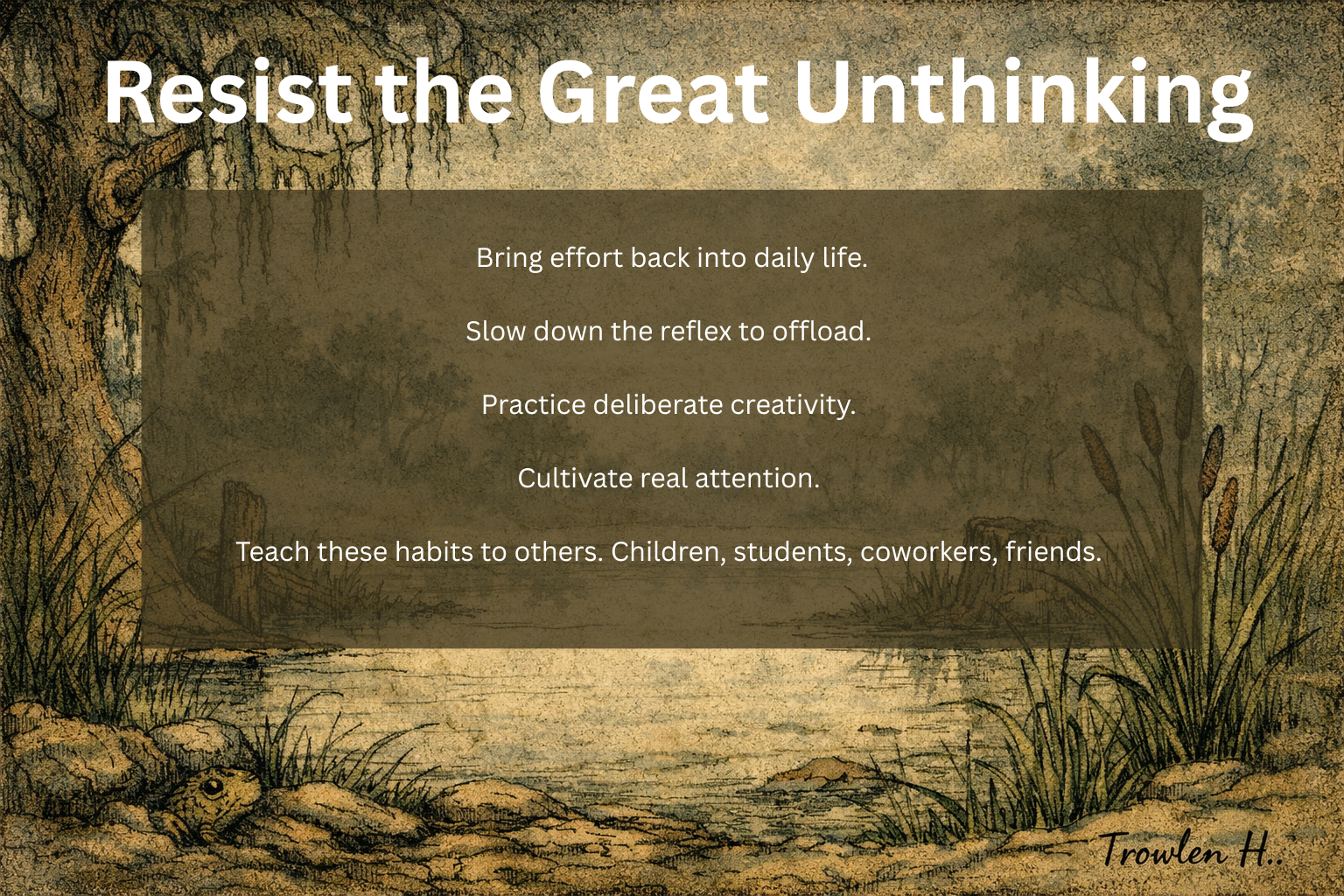
How to Resist the Great Unthinking
Avoiding the future we just described does not require abandoning technology or rejecting AI. It requires reclaiming the parts of thinking that make us human. The mind strengthens only when it is used, and it weakens when it is outsourced.
STEP ONE — bring effort back into daily life. Choose tasks that require memory, reasoning, and attention. Remember a few passwords instead of storing all of them. Read a chapter without asking a machine to summarize it. Write a paragraph before asking an assistant to refine it. These small acts rebuild the cognitive muscles that passive tools quietly erode, a pattern reflected in studies showing reduced memory retention when learners rely on AI summaries instead of engaging with the material (Akgun and Toker 2024; Bai, Liu, and Su 2023).
STEP TWO — slow down the reflex to offload. When a question arises, resist the urge to ask a machine for the answer. Think about it first. Hold the idea in your mind long enough for your own reasoning to engage. The act of wrestling with a problem, even briefly, strengthens the neural pathways that make future thinking easier, and aligns with findings that higher confidence in AI leads to lower cognitive effort (Lee et al. 2025)
Generative AI and Critical Thinking
The Impact of Generative AI on Critical Thinking
Source: Hao-Ping (Hank) Lee et al., "The Impact of Generative AI on Critical Thinking: Self-Reported Reductions in Cognitive Effort and Confidence Effects From a Survey of Knowledge Workers," CHI '25 (2025).
Summary
The researchers surveyed 319 knowledge workers who used generative AI at least weekly and collected 936 examples of its use in real work. Participants described when they applied critical thinking and how much effort it required. The analysis found that greater confidence in AI's ability to perform a task was associated with less reported critical-thinking effort, while greater confidence in one's own ability was associated with more critical thinking.
AI did not simply eliminate critical thought; it changed where that thought occurred. Workers shifted effort from gathering information to verifying it, from directly solving problems to integrating AI responses, and from performing tasks to supervising them. Participants checked outputs against external sources, selected useful portions, adapted content to local circumstances, and revised style or tone. The authors warn that efficiency can still encourage overreliance and weaken independent problem-solving if users lack the awareness, motivation, or ability to evaluate results.
Why It Matters Here
The study supports the rambling's claim that trust in AI can reduce the effort people invest in evaluating its work. It also adds an important qualification: thoughtful use can relocate critical thinking into verification and stewardship rather than remove it entirely.
Important Limits
The results are based on participants' self-reports and recalled examples, not direct cognitive testing or longitudinal measurement. The observed relationships are associations and do not prove that AI caused a lasting decline in critical-thinking ability.
STEP THREE — practice deliberate creativity. Do not let AI be the first voice in the room. Sketch an idea before generating one. Brainstorm without a screen. Let your imagination wander without a machine nudging it toward familiar patterns. Creativity grows only when it is exercised, and research shows that AI assisted idea generation increases fluency but reduces originality and flexibility (Habib et al. 2024).
STEP FOUR — cultivate real attention. Turn off the constant stream of alerts and recommendations. Spend time in silence. Let your mind wander without being pulled toward the next distraction. Attention is the foundation of memory, and memory is the foundation of thought. Studies on cognitive offloading show that constant reliance on external tools reduces the frequency of moments when the brain must engage deeply (Risko and Gilbert 2016).
STEP FIVE — teach these habits to others. Children, students, coworkers, friends. Thinking is contagious when people see it practiced. So is not thinking. The Great Unthinking spreads quietly, but so does the cure. Early research in educational settings shows that AI can reduce student motivation and engagement when used passively (Neji, Boughattas, and Ziadi 2023), reinforcing the need to model active thinking.
Trowlen Thoughts
When I step back from all of this, the thing that hits me hardest is how easy it is to slip into the Great Unthinking without noticing. I have seen it in students, coworkers, friends, and I have seen it in myself. None of us woke up one morning and decided to think less. It just happened, one convenience at a time, until the effort that used to feel normal started to feel uncomfortable.
But the good news is that this is not some irreversible collapse. It is a habit. And habits can be changed. We do not need to throw away our tools or pretend we live in a world without AI. We just need to start using our minds again on purpose. A little more memory. A little more attention. A little more curiosity. A little more discomfort. These small things matter.
The research is clear, but honestly, so is everyday life. You can feel the difference between thinking and not thinking. I find myself at times having to pause and think to finish a sentence, or to explain an idea. You can feel when your mind is engaged and when it is coasting. You can feel when you are choosing convenience over understanding. And you can feel when you decide to push back.
The future does not depend on whether AI gets smarter. It depends on whether we stay awake. Whether we keep the parts of thinking that make us human. Whether we choose to stay mentally present in a world that keeps offering us ways to drift.
The Great Unthinking is real. But it is not inevitable.
It comes down to what each of us decides to do next.
And that choice is still ours.
Notes & Bibliography
Boston, M. D., M. S. Smith, and A. F. Hillen. “Building on Students’ Intuitive Strategies to Make Sense of Cross Multiplication.” Mathematics Teaching in the Middle School 9 (2003): 150–155.
Faulkenberry, Thomas J. “The Conceptual/Procedural Distinction Belongs to Strategies, Not Tasks: A Comment on Gabriel et al. (2013).” Frontiers in Psychology 4 (2013): 820.
Conceptual and Procedural Strategies
The Conceptual/Procedural Distinction Belongs to Strategies, Not Tasks
Source: Thomas J. Faulkenberry, "The Conceptual/Procedural Distinction Belongs to Strategies, Not Tasks: A Comment on Gabriel et al. (2013)," Frontiers in Psychology 4 (2013): 820.
Summary
Faulkenberry argues that researchers should not automatically label a mathematics task as either conceptual or procedural. The same task can be solved through genuine understanding or through a memorized rule. For example, a student might compare fractions by reasoning about their magnitudes or by mechanically cross-multiplying; the correct answer alone does not reveal which kind of knowledge the student used.
The commentary recommends examining the learner's strategy, ideally by asking how the answer was reached, rather than inferring understanding from the task or result. It also recommends independent review of how researchers classify tasks when direct strategy reports are impractical.
Why It Matters Here
The paper illustrates the gap between successful output and actual understanding. A person can produce a correct answer by following a procedure without building the conceptual knowledge needed to explain, adapt, or independently reproduce it - the same distinction raised in the rambling's examples of AI-generated school and workplace writing.
Important Limits
This is a short scholarly commentary about mathematics research, not an empirical study of AI or cognitive decline. Its relevance to generative AI is an analogy: polished performance does not necessarily demonstrate that learning or deep thinking occurred.
Gabriel, F., F. Coché, D. Szucs, V. Carette, B. Rey, and A. Content. “A Componential View of Children’s Difficulties in Learning Fractions.” Frontiers in Psychology 4 (2013): 715.
Gerlich, R. Study on AI Dependence and Critical Thinking Decline. Mixed‑methods study summarized in ANSI Blog, 2025.
Grinschgl, S., and A. Neubauer. “Supporting Cognition with Modern Technology: Distributed Cognition Today and in an AI‑Enhanced Future.” Frontiers in Artificial Intelligence 5 (2022): 908261.
Habib, S., T. Vogel, X. Anli, and E. Thorne. “How Does Generative Artificial Intelligence Impact Student Creativity?” Journal of Creativity 34 (2024): 100072.
Hallett, D., T. Nunes, and P. Bryant. “Individual Differences in Conceptual and Procedural Knowledge When Learning Fractions.” Journal of Educational Psychology 102 (2010): 395–406.
Hecht, S. A., and K. J. Vagi. “Patterns of Strengths and Weaknesses in Children’s Knowledge About Fractions.” Journal of Experimental Child Psychology 111 (2012): 212–229.
Jose, Binny, Jaya Cherian, Alie Molly Verghis, Sony Mary Varghise, Mumthas S, and Sibichan Joseph. “The Cognitive Paradox of AI in Education: Between Enhancement and Erosion.” Frontiers in Psychology 16 (2025): 1550621.
The Cognitive Paradox of AI in Education
The Cognitive Paradox of AI in Education
Source: Binny Jose et al., "The Cognitive Paradox of AI in Education: Between Enhancement and Erosion," Frontiers in Psychology 16 (2025): 1550621.
Summary
This opinion article examines educational AI through Cognitive Load Theory, Bloom's Taxonomy, and Self-Determination Theory. The authors argue that AI can personalize instruction, provide feedback, and reduce distracting or unnecessary mental load. At the same time, it can remove the productive effort needed to build understanding, weaken independent problem-solving, encourage dependency, and reduce motivation when it supplies answers in place of thought.
The authors advocate blended use rather than rejection of AI. They recommend choosing tools that promote engagement, retaining teacher-led discussion and human interaction, requiring students to explain AI-provided answers in their own words, scheduling AI-free problem-solving, monitoring outcomes, and designing activities that preserve autonomy and higher-order thinking.
Why It Matters Here
The article supplies the distinction at the heart of the rambling: assistance is beneficial when it reduces irrelevant burden while preserving the mental work that produces learning. AI becomes harmful when efficiency eliminates that necessary work.
Important Limits
The publication is explicitly categorized as an opinion article. It synthesizes theories and selected examples but does not report a new controlled experiment, and some evidence it cites comes from secondary or nonacademic sources. Its recommendations are reasoned proposals rather than directly tested conclusions from this paper.
Khalil, F. S. The Role of Artificial Intelligence in Language Learning. Doctoral dissertation, University of Baghdad, 2024.
Lee, Hao‑Ping (Hank), Ian Drosos, Advait Sarkar, Sean Rintel, Nicholas Wilson, Lev Tankelevitch, and Richard Banks. “The Impact of Generative AI on Critical Thinking: Self‑Reported Reductions in Cognitive Effort and Confidence Effects From a Survey of Knowledge Workers.” In CHI Conference on Human Factors in Computing Systems (CHI ’25), 1–23. ACM, 2025.
Generative AI and Critical Thinking
The Impact of Generative AI on Critical Thinking
Source: Hao-Ping (Hank) Lee et al., "The Impact of Generative AI on Critical Thinking: Self-Reported Reductions in Cognitive Effort and Confidence Effects From a Survey of Knowledge Workers," CHI '25 (2025).
Summary
The researchers surveyed 319 knowledge workers who used generative AI at least weekly and collected 936 examples of its use in real work. Participants described when they applied critical thinking and how much effort it required. The analysis found that greater confidence in AI's ability to perform a task was associated with less reported critical-thinking effort, while greater confidence in one's own ability was associated with more critical thinking.
AI did not simply eliminate critical thought; it changed where that thought occurred. Workers shifted effort from gathering information to verifying it, from directly solving problems to integrating AI responses, and from performing tasks to supervising them. Participants checked outputs against external sources, selected useful portions, adapted content to local circumstances, and revised style or tone. The authors warn that efficiency can still encourage overreliance and weaken independent problem-solving if users lack the awareness, motivation, or ability to evaluate results.
Why It Matters Here
The study supports the rambling's claim that trust in AI can reduce the effort people invest in evaluating its work. It also adds an important qualification: thoughtful use can relocate critical thinking into verification and stewardship rather than remove it entirely.
Important Limits
The results are based on participants' self-reports and recalled examples, not direct cognitive testing or longitudinal measurement. The observed relationships are associations and do not prove that AI caused a lasting decline in critical-thinking ability.
Neji, W., N. Boughattas, and F. Ziadi. “Exploring New AI‑Based Technologies to Enhance Students’ Motivation.” Issues in Informing Science and Information Technology 20 (2023): 95–110.
Ododo, Emmanuel Philip, Iniobong U. B., Udoessien A. I., Ukpe I. U., and James O. D. “Artificial Intelligence in the Classroom: Perceived Challenges to Vocational Education Student Retention and Critical Thinking in Tertiary Institutions.” American Journal of Interdisciplinary Innovative Research 6 (2024): 30–39.
Pew Research Center. How Americans View AI and Its Impact on People and Society. September 17, 2025.
Rittle‑Johnson, Bethany, and Martha W. Alibali. “Conceptual and Procedural Knowledge of Mathematics: Does One Lead to the Other?” Journal of Educational Psychology 91 (1999): 175–189.
Risko, E. F., and S. J. Gilbert. “Cognitive Offloading.” Trends in Cognitive Sciences 20 (2016): 676–688.
Schnotz, Wolfgang, and Christian Kürschner. “A Reconsideration of Cognitive Load Theory.” Educational Psychology Review 19 (2007): 469–508.
Shaikh, S., S. M. Daudpotta, and A. S. Imran. “Bloom’s Learning Outcomes’ Automatic Classification Using LSTM and Pretrained Word Embeddings.” IEEE Access 9 (2021): 117887–117909.
Sternberg, Robert J. “Do Not Worry That Generative AI May Compromise Human Creativity or Intelligence in the Future: It Already Has.” Journal of Intelligence 12 (2024): 69.
Generative AI, Creativity, and Intelligence
Do Not Worry That Generative AI May Compromise Human Creativity or Intelligence in the Future: It Already Has
Source: Robert J. Sternberg, "Do Not Worry That Generative AI May Compromise Human Creativity or Intelligence in the Future: It Already Has," Journal of Intelligence 12 (2024): 69.
Summary
Sternberg argues that technologies change both what society considers intelligent and which abilities people continue to practice. Generative AI can improve or accelerate a person's output, but repeated delegation may weaken the underlying human skills through a "use it or lose it" effect. He is particularly concerned about intellectual ownership, undetected AI authorship, misinformation, dependence, and the possibility that people will mistake an AI-produced result for evidence of their own creativity.
The essay distinguishes recombination from paradigm-changing creativity. AI can rearrange existing material and may make some products appear more creative, but Sternberg questions whether it can supply the original, wise, and socially responsible ideas needed to address unfamiliar human problems. His concern is therefore not simply whether AI output is useful, but what happens to human adaptability and creativity when people stop exercising them.
Why It Matters Here
This essay provides the rambling's "use it or lose it" framework and supports its warning that a society can gain more polished products while the people producing them become less practiced at independent thought and creation.
Important Limits
This is a theoretical and argumentative essay, not an experiment measuring changes in intelligence or creativity. Its examples and cited literature support a warning and a framework for interpretation, but the paper does not establish a population-wide causal decline attributable to generative AI.
ANSI. Enhancing Critical Thinking with AI: A Practical Guide. The ANSI Blog, August 19, 2025.
ANSI. Is AI Eroding Our Critical Thinking Skills? The ANSI Blog, August 18, 2025.
Akgun, Mustafa, and Serkan Toker. Evaluating the Effect of Pretesting with Conversational AI on Retention of Needed Information. arXiv:2412.13487, 2024.
Alawneh, Yazan, Hani Sleema, Fadi Salman, Mohammad F. Alshammat, Rami Oteer, and N. K. N. Alrashidi. “Adaptive Learning Systems: Revolutionizing Higher Education Through AI‑Driven Curricula.” In 2024 International Conference on Knowledge Engineering and Communication Systems (ICKECS), 1–5.
Bai, L., X. Liu, and J. Su. “ChatGPT: The Cognitive Effects on Learning and Memory.” Brainat 1 (2023): e30.
Barshay, Jill. “Kids Who Use ChatGPT as a Study Assistant Do Worse on Tests.” The Hechinger Report, September 2, 2024.
Çela, E., M. M. Fonkam, and R. Potluri. “Risks of AI‑Assisted Learning on Student Critical Thinking.” International Journal of Risk and Contingency Management 12 (2024): 1–19.
Chinta, S. V., Z. Wang, Z. Yin, N. Hoang, M. Gonzalez, T. L. Quy, et al. FairAIED: Navigating Fairness, Bias, and Ethics in Educational AI Applications. arXiv:2407.18745, 2024.
Correia, A., P. Água, and V. Lobo. “Adaptive Learning Design: Integrating AI to Personalize Critical Thinking Education.” EDULEARN24 Proceedings (2024): 7733–7741.
Voices from the swamp
Reader Responses
Thoughtful disagreement is welcome. Harpies, advertisements, and personal attacks will be left outside the marsh.
The frogs are listening, but nobody has spoken yet.
Respond to this rambling
Before feeding the frogs, read the swamp rules
The Swamp Rules and Comment Privacy Policy
A Word Before You Feed the Frogs
This is Trowlen's swamp, but thoughtful visitors are welcome to pull up a reasonably dry log and disagree with me. You do not need to flatter the troll. You do need to behave like a human being who remembers that another human being is reading.
The Swamp Rules
Disagreement is welcome. Personal attacks, threats, harassment, impersonation, cruelty, and attempts to expose someone else's private information are not.
Spam, advertisements, repetitive promotion, and comments written mainly to manipulate search engines will not be published.
Stay reasonably close to the subject of the rambling. Frogs wander; conversations may wander a little too. They should not disappear into an entirely different marsh.
Do not submit material you do not have the right to share.
Every comment is moderated. Submission does not guarantee publication, and Trowlen may approve, decline, or later remove a comment.
Approved comments are normally published as submitted. Obvious formatting problems may be corrected, but I will not quietly rewrite your argument and pretend the revised creature was yours.
What the Swamp Saves
When you submit a comment, the site saves the display name, email address, optional website URL, comment text, the rambling you responded to, the submission time, and your acceptance of this policy. The comment receives a random internal identifier and remains private while waiting for moderation.
Your email address is used to identify and review the submission and to make direct contact possible if that becomes necessary. It is not displayed with an approved comment, sold, rented, used for advertising, or added to a mailing list.
If you provide a website URL, it is saved with the private comment record. It is also added to a separate private text file that Trowlen uses as a personal list of websites to visit, read, and possibly respond to. That URL list is independent of the comment archive. Removing a comment does not automatically remove its URL from the private list.
Approved comments publicly display the submitted display name, comment text, submission date, and optional website link. If Trowlen writes a response while approving the comment, that response is displayed with it. Reader website links are marked so search engines know they are user-submitted links.
Disapproved comments are moved into a private archive instead of being published. Pending, approved, and disapproved records are currently retained indefinitely. This allows Trowlen to reconsider an old decision, preserve the history of a conversation, or use a private submission as a future point of reflection. Archived folders may occasionally be removed manually.
The site uses a hidden anti-spam field, submission timing and rate checks, a session-bound security token, and Google reCAPTCHA. reCAPTCHA processes technical information under Google's own privacy policy and terms. The web server may also retain ordinary access and security logs. The comment record itself does not intentionally store your IP address.
The saved information is used only to receive, moderate, publish, answer, secure, and maintain comments; to prevent abuse; and to maintain the private website list described above. It is not sold or shared for behavioral advertising.
If you want a published or privately retained comment removed, use the site's contact page and provide enough information to identify it. I may need to confirm that the request came from the same email address used for the submission.
By checking the policy box and submitting a comment, you confirm that you have read and accepted these rules. In shorter Trowlen terms: disagree freely, speak honestly, leave the harpy costume at home, and remember that the frogs are listening.

Voices from the swamp
Reader Responses
Thoughtful disagreement is welcome. Harpies, advertisements, and personal attacks will be left outside the marsh.
The frogs are listening, but nobody has spoken yet.
Respond to this rambling
Before feeding the frogs, read the swamp rules
A Word Before You Feed the Frogs
This is Trowlen's swamp, but thoughtful visitors are welcome to pull up a reasonably dry log and disagree with me. You do not need to flatter the troll. You do need to behave like a human being who remembers that another human being is reading.
The Swamp Rules
What the Swamp Saves
When you submit a comment, the site saves the display name, email address, optional website URL, comment text, the rambling you responded to, the submission time, and your acceptance of this policy. The comment receives a random internal identifier and remains private while waiting for moderation.
Your email address is used to identify and review the submission and to make direct contact possible if that becomes necessary. It is not displayed with an approved comment, sold, rented, used for advertising, or added to a mailing list.
If you provide a website URL, it is saved with the private comment record. It is also added to a separate private text file that Trowlen uses as a personal list of websites to visit, read, and possibly respond to. That URL list is independent of the comment archive. Removing a comment does not automatically remove its URL from the private list.
Approved comments publicly display the submitted display name, comment text, submission date, and optional website link. If Trowlen writes a response while approving the comment, that response is displayed with it. Reader website links are marked so search engines know they are user-submitted links.
Disapproved comments are moved into a private archive instead of being published. Pending, approved, and disapproved records are currently retained indefinitely. This allows Trowlen to reconsider an old decision, preserve the history of a conversation, or use a private submission as a future point of reflection. Archived folders may occasionally be removed manually.
The site uses a hidden anti-spam field, submission timing and rate checks, a session-bound security token, and Google reCAPTCHA. reCAPTCHA processes technical information under Google's own privacy policy and terms. The web server may also retain ordinary access and security logs. The comment record itself does not intentionally store your IP address.
The saved information is used only to receive, moderate, publish, answer, secure, and maintain comments; to prevent abuse; and to maintain the private website list described above. It is not sold or shared for behavioral advertising.
If you want a published or privately retained comment removed, use the site's contact page and provide enough information to identify it. I may need to confirm that the request came from the same email address used for the submission.
By checking the policy box and submitting a comment, you confirm that you have read and accepted these rules. In shorter Trowlen terms: disagree freely, speak honestly, leave the harpy costume at home, and remember that the frogs are listening.