Don't be a Jonah
(written 46 days ago) 76 no comments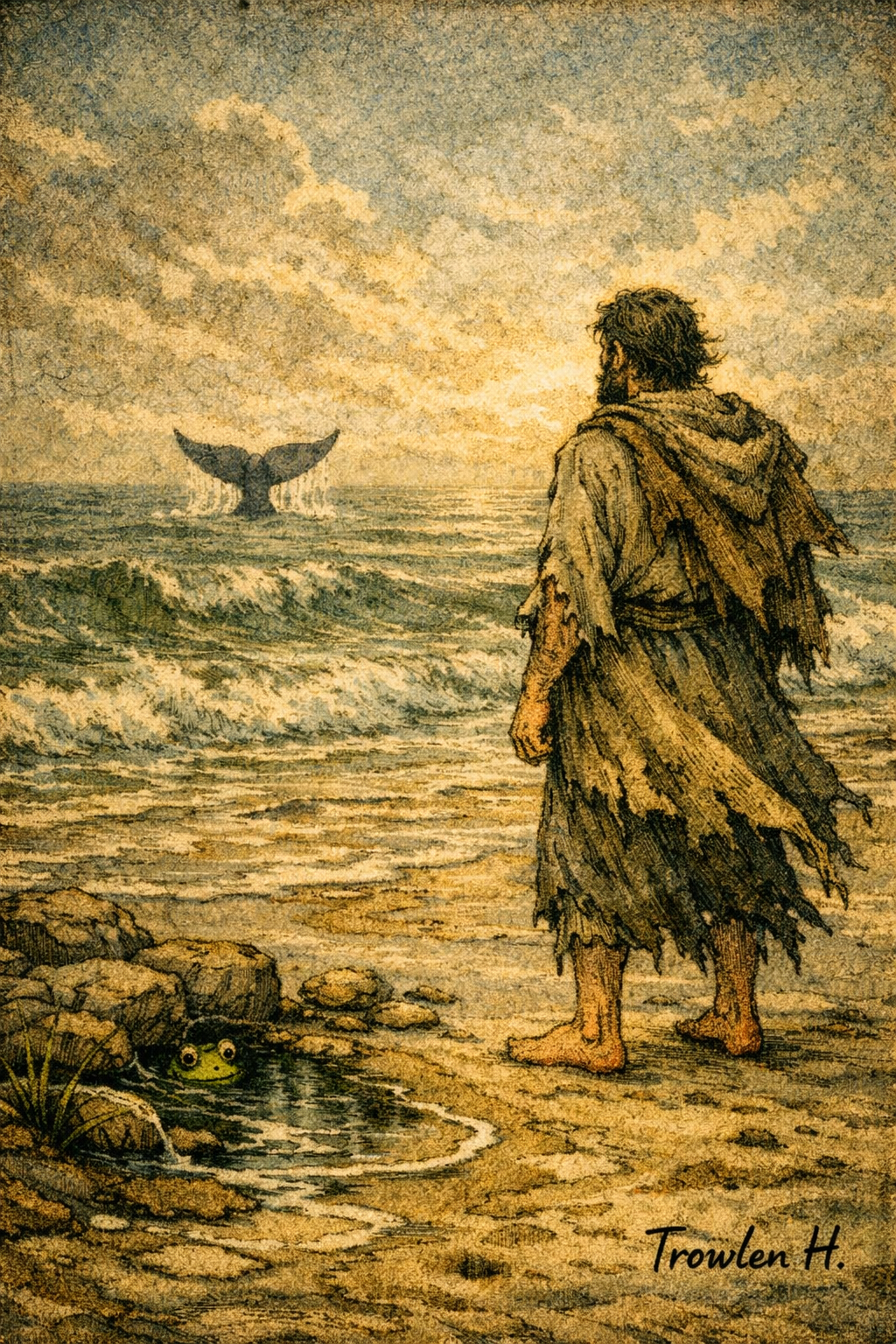 To quote a children's hymn Follow the Prophet, "Jonah was a prophet, tried to run away, but he later learned to listen and obey." Over the course of my swamp-filled life, I have come to understand Jonah. You could even say that I have followed Jonah, but it is time for me to put that aside and move on. (Frogs are joyfully chirping and clapping, if they could, in the background.) I think I even heard one of them say, "Bout time."
Of the books in the Old Testament, Jonah is the 4th smallest book. It only contains 4 chapters, 48 verses, and a total of 1,320 words. Being such a small book, and the fact it is in the Old Testament, I feel it gets overlooked most of the time. But I think that the lessons taught in this small book are important.
I think there are two lessons. The first is don't run from your potential, and the second is don't get mad when the Lord does the unexpected. Remember, like anything in the scriptures, these lessons may not apply to you, ring true to you currently, and then maybe in the future they will, or in the past they have. I have learned that reading the same scripture or parable at different times in life can make it mean different things and impact you in different ways. At this point in my life and at this time, this is what the book of Jonah is saying to me.
Lesson One
The Lord asked Jonah to go to the city of Nineveh to cry against the city because "their wickedness is come up before me." Just to give you some perspective on this request. Nineveh was the capital of the Assyrian Empire, and it is located on the east bank of the Tigris River. This was one of the largest cities of the ancient world. Some modern archaeological highlights give us some details of how major of a player this city was. The wall to Nineveh was 7.5 miles long and was protected by 15 massive gates. It contained the Library of Ashurbanipal, which housed over 30,000 clay tablets, making it arguably the largest literary archive in the ancient Near East. In Chapter 3 Jonah himself tells us that it is a huge city: "Now Nineveh was an exceedingly great city of three days' journey."
I interpret this to mean it would take three days to walk from one end to the other end. But as my frogs remind me, I am not a historian or a scriptorian.I can totally understand why Jonah would not want to travel to Nineveh and tell them the Lord is displeased with them and they are about to be destroyed. The purpose of this post is not to go through the journey that Jonah took to get to Nineveh, or how the Lord had to persuade him to go, but to focus on the fact he did not want to go.
I find myself in life plenty of times knowing what the Lord would want me to do, but I run from it. We have been asked to do the basics: pray, read scriptures, be nice, etc. But with all of those asks, it is implied that the Lord will require more of you. The more you know, the more you do, the more the Lord expects you to do, and the more He requires of you. Like Jonah, I find myself running in the opposite direction. Let's not be like Jonah and shirk responsibility just because it may lead to more responsibility.
In my mind and to my frogs, I find myself saying... Yeah, but if I do that, then the Lord may want me to do this, and this, and this. So at times, I keep the favorite sin, don't follow the basics, hoping that the responsibility and the call of the Lord won't increase.
Lesson Two
The second lesson that I get from the story of Jonah in the Bible is that the Lord works in his own ways, and don't get upset when he does not do what you expect. So after Jonah ran, was swallowed by a whale, and spat out on the beach, he went to Nineveh. And when he did, he cried and said, "Yet forty days, and Nineveh shall be overthrown."
But that was not what happened. The people of Nineveh believed God and what was said by Jonah. The king even did a proclamation that was published throughout Nineveh. "And God saw their works that they turned from their evil way.." But that was not what Jonah wanted to happen, and he threw another fit and ran from the Lord. He left the city and made a shelter to pout in. While he was sitting there, a bean plant (gourd) grew next to him that gave him shade from the sun. I see visions of Jack and the Beanstalk. Remember Nineveh is located where Iraq now sits; I would not want to be in the sun for long, and I know it would kill my frogs. The next morning a worm came and killed the plant. And this is the important part, what the Lord said to Jonah after he complained about the worm that killed the plant. "Doest thou well to be angry for the gourd?" Jonah responded, "I do well to be angry, even unto death." The Lord then responded, "Thou has had pity on the gourd, for which thou hast not laboured, neither made it grow; which came up in a night and perished in a night." Basically pointing out to Jonah that he was upset about something out of his control that was only there for a single day. The Lord then continued, "And should not I spare Nineveh, that great city, wherein are more than sixscore thousand persons (120,000+) that cannot discern between their right hand and their left hand; and so much cattle?"
The moral of the story: don't lament the death of a plant and be mad that God did not save it, and not notice or celebrate when the Lord saves sixscore thousand souls.
I find myself at times running away from what I know the Lord wants me to do, like Jonah. And then I find myself getting angry with the Lord over small and meaningless things. Let's not be like Jonah, but run towards what the Lord wants us to do, and to accept what he does and how he does it.
I know. I know, talking to my frogs, it is easy to say, and yes, I will probably be hypocritical and run at times and grumble at others. But the goal is to become better and grow, not be perfect overnight.
The children's hymn continues
When we really try, the Lord won’t let us fail: That’s what Jonah learned deep down inside the whale.
Follow the prophet, follow the prophet, Follow the prophet; don’t go astray. Follow the prophet, follow the prophet, Follow the prophet; he knows the way.
Trowlen H., watching the horizon for the next call.

Voices from the swamp
Reader Responses
Thoughtful disagreement is welcome. Harpies, advertisements, and personal attacks will be left outside the marsh.
The frogs are listening, but nobody has spoken yet.
Respond to this rambling
Before feeding the frogs, read the swamp rules
A Word Before You Feed the Frogs
This is Trowlen's swamp, but thoughtful visitors are welcome to pull up a reasonably dry log and disagree with me. You do not need to flatter the troll. You do need to behave like a human being who remembers that another human being is reading.
The Swamp Rules
What the Swamp Saves
When you submit a comment, the site saves the display name, email address, optional website URL, comment text, the rambling you responded to, the submission time, and your acceptance of this policy. The comment receives a random internal identifier and remains private while waiting for moderation.
Your email address is used to identify and review the submission and to make direct contact possible if that becomes necessary. It is not displayed with an approved comment, sold, rented, used for advertising, or added to a mailing list.
If you provide a website URL, it is saved with the private comment record. It is also added to a separate private text file that Trowlen uses as a personal list of websites to visit, read, and possibly respond to. That URL list is independent of the comment archive. Removing a comment does not automatically remove its URL from the private list.
Approved comments publicly display the submitted display name, comment text, submission date, and optional website link. If Trowlen writes a response while approving the comment, that response is displayed with it. Reader website links are marked so search engines know they are user-submitted links.
Disapproved comments are moved into a private archive instead of being published. Pending, approved, and disapproved records are currently retained indefinitely. This allows Trowlen to reconsider an old decision, preserve the history of a conversation, or use a private submission as a future point of reflection. Archived folders may occasionally be removed manually.
The site uses a hidden anti-spam field, submission timing and rate checks, a session-bound security token, and Google reCAPTCHA. reCAPTCHA processes technical information under Google's own privacy policy and terms. The web server may also retain ordinary access and security logs. The comment record itself does not intentionally store your IP address.
The saved information is used only to receive, moderate, publish, answer, secure, and maintain comments; to prevent abuse; and to maintain the private website list described above. It is not sold or shared for behavioral advertising.
If you want a published or privately retained comment removed, use the site's contact page and provide enough information to identify it. I may need to confirm that the request came from the same email address used for the submission.
By checking the policy box and submitting a comment, you confirm that you have read and accepted these rules. In shorter Trowlen terms: disagree freely, speak honestly, leave the harpy costume at home, and remember that the frogs are listening.