
One Leg at a Time
(written 38 days ago) 67 no comments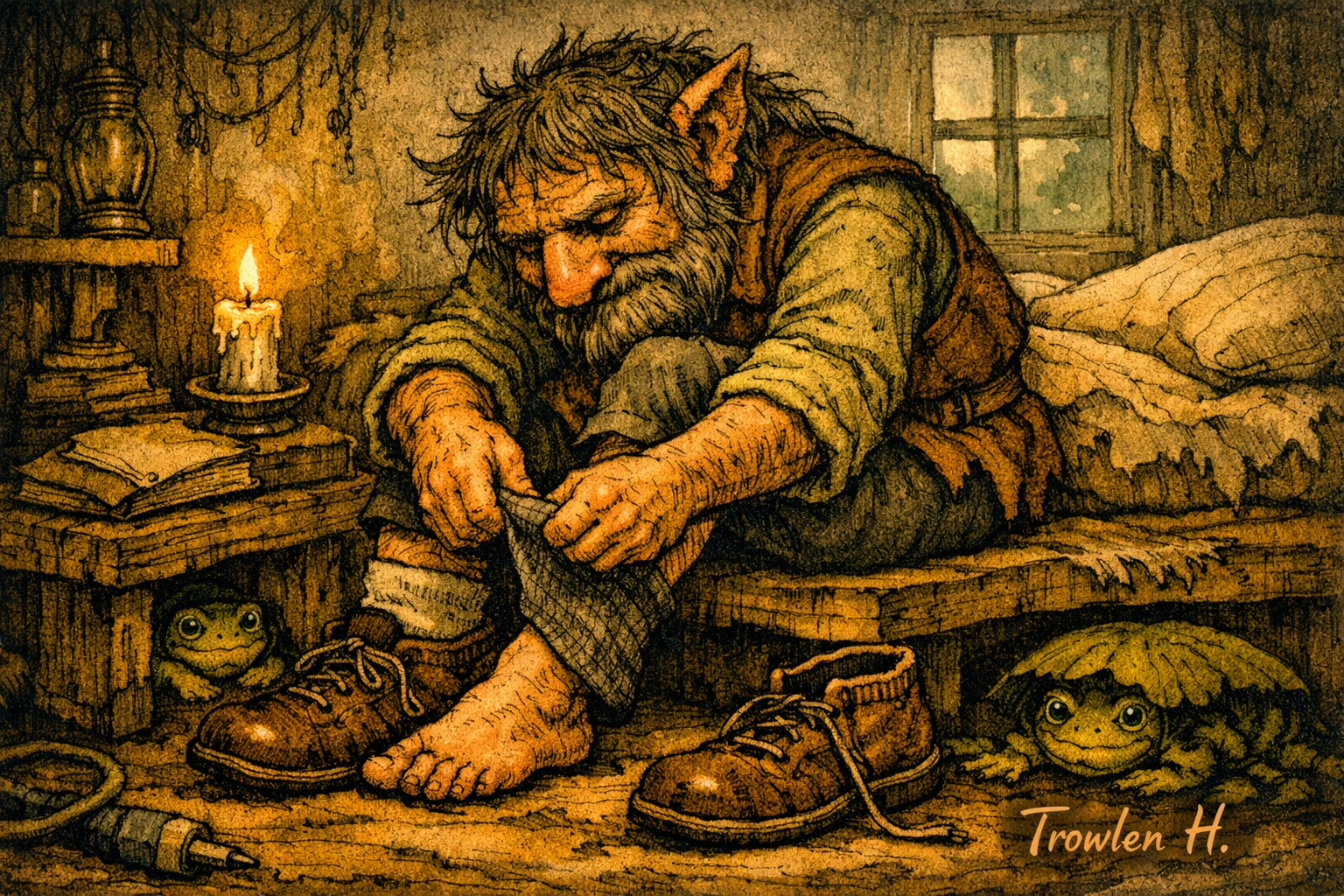
Some years ago, closer to a few decades, if I’m honest, I sat in a soft chair and told my troubles to Dr. E, the head doctor I visited in those days. Back then the frogs had not started to sing their song in my head. I was lamenting about how hard life was and how I wished I were as great as other people. He told me about him having an issue with someone bigger than him giving him grief. And his dad told him that everyone "puts their pants on one leg at a time." I have thought about this and wondered if it was actually true. Are mornings and getting dressed the great equalizer? The term can be traced back to several sports pep talks. In 1919, Center College quarterback Bo McMillain told his teammates before facing West Virginia (still one of my favorite states) that, "They're nothing but men - they all put their football pants on one leg at a time, same as you do." The small Kentucky College went on to beat West Virginia 14-6. Eventually leading them to a legendary 1921 victory over Harvard. By the mid-1900s, the term had broadened beyond sports. It became a saying to show that status doesn't change basic human limitations, that everyone at some time is a normal person.
But is the term really true? Does everyone actually put their pants on one leg at a time? These are the kinds of questions that drift through my head when my mind takes its slow walk through the swamp. There ARE other ways, after all, and methods. You have the jump‑in method, the sit‑down method, the both‑legs‑together pull‑up, the lying‑in‑bed shuffle, or the old standby: pants already waiting around the ankles. The last one I guess would be the one foot at a time not one leg at a time method. Folks are inventive when the day hasn’t quite decided what it wants from them yet.
One thing that I have found while wandering the swamps is that humans like to think out of the box, and do things that people would think are unpredictable. I know plenty of individuals that even pattern their lives to avoid the ordinary or the predictable.
Here is an example. Once I remember discussing how people put their shoes on, and I was told I was a freak because of the way I do it. I try to be efficient, so I only lift one leg at a time and only lift it up once. This is how I put my socks and shoes on, well, most of the time. First I lift one leg, put the sock on that foot, and then put the shoe on the same foot. Leaving my other foot completely naked without a sock or shoe when I am done with the first leg. Then I pick up the second leg and put the sock and shoe on it. Done, and I only had to lift each leg once.
This is just something I have been thinking about: how normal is normal, and is normal really the best way to do it? Just because you don't conform to how something is usually done does not make you a freak. It may just make you different, a little smarter, or, in my case, lazy. (Wow, check out how many commas I put in that sentence.) I just don't want to have to lift both of my feet twice instead of once.
I am trying hard to move away from the mindset that everything has to be done a specific way, and that if you deviate from the standard way, then you are weird, a freak, or something else. Just think of all of the inventions that we have that we now use that were developed by people who thought differently, wanted to find a different way of doing it. Imagine if someone, way back when, refused to believe that walking was the only way to get from point A to point B. That single doubt or question eventually unraveled into riding animals, then wagons, then bicycles, then automobiles, then trains, then airplanes, and finally rockets slipping loose of the whole planet.
Let’s dive a little deeper into the swamp. What if a baby never questioned its surroundings and decided that staring at the ceiling was plenty? But babies don’t stay still. Something in them — curiosity, stubbornness, hunger, or maybe just that ancient itch to see what’s over there — pushes them forward. First a roll, then a crawl, then a stand, then a step. And from that single step comes everything else: walking, running, riding, driving, flying, and eventually the wild notion that maybe I can change the way I put on my socks and shoes. Any parent that has watched a kid get dressed has seen that they don't always put their pants on one leg at a time. I still find one frog walking around with its shirt on backwards half the time.
This makes me also think, that maybe when God says to be as a little child, perhaps he is not saying to be submissive and obedient, but to be like a child, question, try, and expand.
And maybe that’s the heart of it. Pants, socks, shoes, walking, babies, all of it, every small ritual of getting ourselves upright and moving, is just proof that we were never meant to stay still. Even God seems to nudge us that way, telling us to be like little children not because they’re obedient, but because they’re brave enough to try things a different way. A baby rolls, a child stumbles, a grown man experiments with how he puts on his pants, and somewhere in all that wobbling and wondering is the quiet reminder that we were made to rise, to move, to question, and to keep stepping forward, one leg — or both — at a time.

Voices from the swamp
Reader Responses
Thoughtful disagreement is welcome. Harpies, advertisements, and personal attacks will be left outside the marsh.
The frogs are listening, but nobody has spoken yet.
Respond to this rambling
Before feeding the frogs, read the swamp rules
A Word Before You Feed the Frogs
This is Trowlen's swamp, but thoughtful visitors are welcome to pull up a reasonably dry log and disagree with me. You do not need to flatter the troll. You do need to behave like a human being who remembers that another human being is reading.
The Swamp Rules
What the Swamp Saves
When you submit a comment, the site saves the display name, email address, optional website URL, comment text, the rambling you responded to, the submission time, and your acceptance of this policy. The comment receives a random internal identifier and remains private while waiting for moderation.
Your email address is used to identify and review the submission and to make direct contact possible if that becomes necessary. It is not displayed with an approved comment, sold, rented, used for advertising, or added to a mailing list.
If you provide a website URL, it is saved with the private comment record. It is also added to a separate private text file that Trowlen uses as a personal list of websites to visit, read, and possibly respond to. That URL list is independent of the comment archive. Removing a comment does not automatically remove its URL from the private list.
Approved comments publicly display the submitted display name, comment text, submission date, and optional website link. If Trowlen writes a response while approving the comment, that response is displayed with it. Reader website links are marked so search engines know they are user-submitted links.
Disapproved comments are moved into a private archive instead of being published. Pending, approved, and disapproved records are currently retained indefinitely. This allows Trowlen to reconsider an old decision, preserve the history of a conversation, or use a private submission as a future point of reflection. Archived folders may occasionally be removed manually.
The site uses a hidden anti-spam field, submission timing and rate checks, a session-bound security token, and Google reCAPTCHA. reCAPTCHA processes technical information under Google's own privacy policy and terms. The web server may also retain ordinary access and security logs. The comment record itself does not intentionally store your IP address.
The saved information is used only to receive, moderate, publish, answer, secure, and maintain comments; to prevent abuse; and to maintain the private website list described above. It is not sold or shared for behavioral advertising.
If you want a published or privately retained comment removed, use the site's contact page and provide enough information to identify it. I may need to confirm that the request came from the same email address used for the submission.
By checking the policy box and submitting a comment, you confirm that you have read and accepted these rules. In shorter Trowlen terms: disagree freely, speak honestly, leave the harpy costume at home, and remember that the frogs are listening.