The Troll, the Crossroads, and Counterfeit Courage
(written 33 days ago) 72 no comments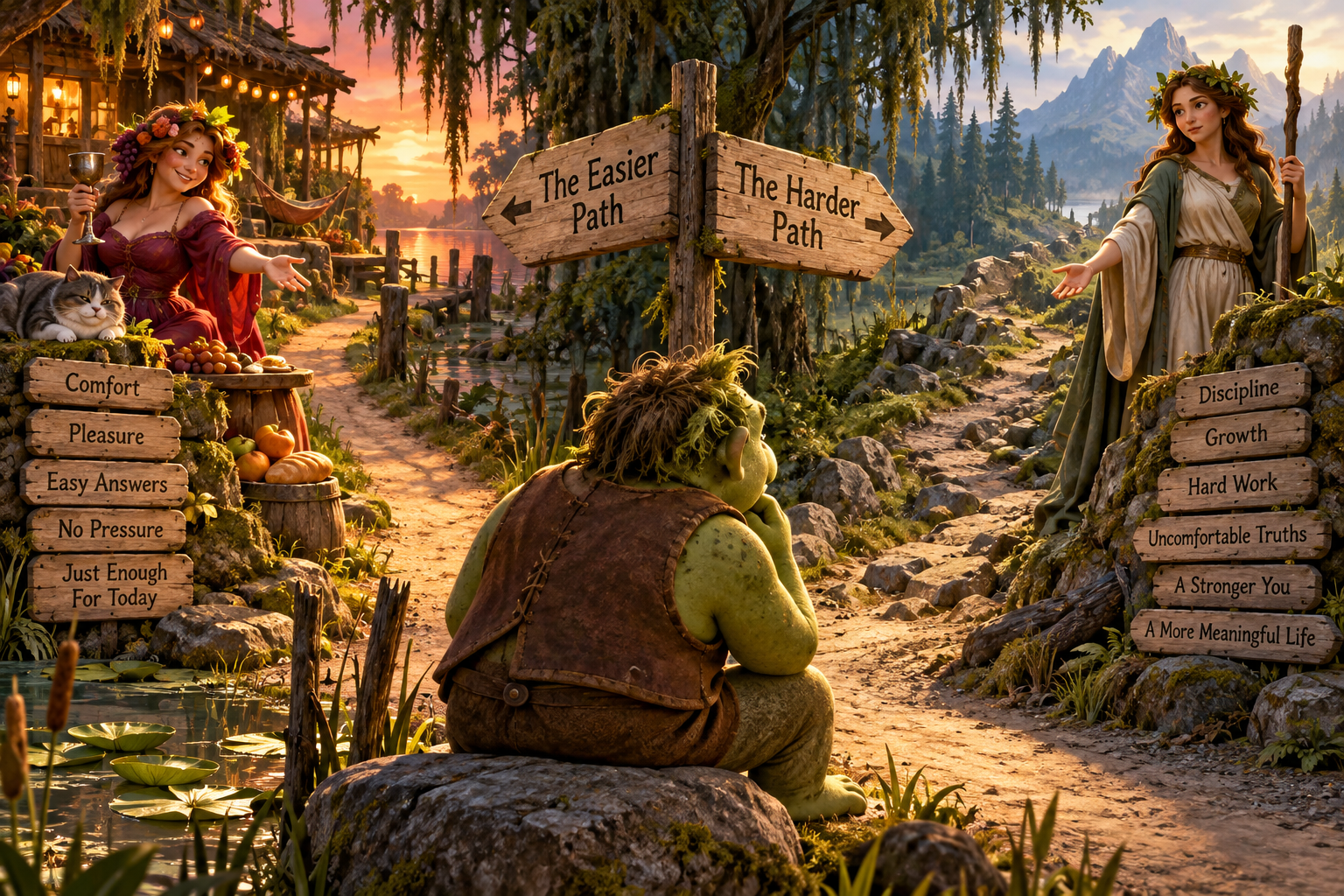
There comes a time in every Troll's life when he has to ignore the Frogs and pick a path. The path may seem unimportant or trivial to everyone else, but that doesn't mean it takes any less courage to walk it.
The Crossroads
Hercules is a young man contemplating what he is going to do with the rest of his life. He finds himself at the proverbial crossroads of life when two women approach him, each offering a different path.
The first is Vice. But, of course, she doesn't introduce herself that way. She offers Hercules the pleasant road. Follow me, she tells him, and you won't have to worry about work, war, responsibility, or hardship. Instead, spend your life thinking about what you want to eat and drink, what you want to see and hear, and how you can live as pleasantly and effortlessly as possible.
When Hercules asks her name, she tells him that her enemies call her Vice, but her friends call her Happiness.
The second woman is Virtue, and she makes a much less attractive sales pitch. She doesn't promise Hercules an easy road. If you want your friends to love you, do good for your friends. If you want your community to honor you, serve your community. If you want the land to produce food, cultivate it. If you want to become skilled at something, learn it and practice it. If you want your body to become strong, train it. Nothing worthwhile simply arrives.
Vice objects. Why would Hercules choose the long and difficult road when she can show him a short and easy road to happiness?
And there sits Hercules, at the crossroads.
(While writing this, I couldn't help but think of Adam and Eve and the choice between remaining in Eden or stepping into a life that included trial, work, sorrow, and growth. There is probably a rambling hiding in those reeds for another day.)
Courage
I have been thinking about courage lately. What is it, what makes it work, what it is not, and how it has changed over time.
What is courage? When we hear the word "courage," we usually picture soldiers, first responders, Hercules fighting monsters, or big acts against big fears. But that leads me to ask some questions. Does something have to be dangerous to require courage? Does courage require fear? If you are not afraid, are you courageous? Is it more courageous for someone to answer the phone or to speak in public?
I think that the one thing that is true about courage is that it can't be measured simply by the size of the thing being faced. But courage does seem to need something to push against. If something is easy, comfortable, and carries no meaningful risk, how much courage does it require? Answering the phone may be a huge act of courage for one person, while public speaking may not for another. Courage is a very personal thing, and like anything personal, it depends on the values, circumstances, and abilities of the one facing the fear. What requires courage from me may require very little from someone else, and what seems trivial to me may require enormous courage from them. That resistance can come in many forms. It can be physical danger, embarrassment, rejection, being wrong (I know this one well), awkwardness, uncertainty, failure, having to apologize, or changing your mind.
If courage needs something to push against, what happens when we spend our lives removing the resistance?
The Stoics were an ancient school of philosophy. They believed that a good life was built around virtue (wisdom, justice, courage, and temperance) and that we should concentrate on what is within our control rather than being ruled by what is not. Hardship itself was not what made someone good or bad; how someone responded to it was what mattered. Some even deliberately practiced discomfort so that they would be better prepared to face it when it did happen.
One of those Stoics was Seneca. He deliberately practiced periods of poverty-like living—rough clothing and simple food—and asked himself whether this was what he had feared. What if courage can be practiced? (This reminds me a little of the idea behind exposure therapy in psychology, although obviously they aren't the same thing.) And what would happen if we removed discomfort? Have we become too good at avoiding discomfort? You don't have to call the restaurant or talk to a cashier—order online. Don't ask someone for directions; just use GPS. Don't knock on someone's door; just text them. Don't have the awkward conversation; just text them. Don't struggle very long with a question; just ask AI.
I find myself using all of these things. But what is the cost? We say it is to make life easier, make us more productive, and remove friction. But what is that really doing to us? I find myself using them not because they are easy, but to avoid embarrassment, rejection, awkwardness, or failure. If deliberately encountering manageable discomfort makes it less controlling, perhaps life's little uncomfortable moments aren't merely annoyances. Ordering food online because it saves twenty minutes isn't necessarily avoiding discomfort. Ordering online because you don't want to speak to another human being might be. Using GPS because you're somewhere unfamiliar is useful. Refusing to ask another person for directions because you're embarrassed to admit you're lost is different. Using AI because it helps you investigate an idea isn't necessarily avoiding friction. Using AI because you don't want to struggle with thinking might be.
Maybe the tool isn't the problem. Maybe I need to ask myself why I am reaching for it. Am I using it because it helps me do something, or am I using it because it helps me avoid something?
Counterfeit Courage
But something strange happens when I go online. We've spent all this time developing tools that allow us to avoid uncomfortable human interactions ... and then we open Facebook and suddenly everybody is Hercules. People become fearless. They'll insult strangers, confront people, proclaim unpopular opinions, tell somebody they're an idiot, and fight battles they'd never dream of fighting face-to-face. If we're becoming so good at avoiding discomfort, why do we appear so courageous online?
We have created online places where we can appear courageous while removing much of what requires courage. We have created places where we can appear courageous while removing much of what requires courage. I can confront a stranger without standing in front of him. I can insult someone without seeing the hurt on her face. I can proclaim what I believe without having to sit across the table from someone who disagrees. If things become uncomfortable, I can block them, mute them, close the browser, or simply walk away.
Yet we have begun to treat this behavior as courage. We call it speaking our minds, standing our ground, telling it like it is, or saying what everyone else is afraid to say. But I wonder if we have confused boldness with courage.
Courage requires something to push against. Online, we have removed much of that resistance while preserving the feeling of having confronted it. We get to feel brave without necessarily being vulnerable. We can even be rewarded for it with likes, shares, and the approval of people who already agree with us.
I have started thinking of this as counterfeit courage. It looks like courage. It may even feel like courage. But like any good counterfeit, something important is missing.
Boldness and courage are not the same thing.
We may be removing the little opportunities to practice courage from everyday life while creating places where we can feel courageous without practicing it.
Voices from the swamp
Reader Responses
Thoughtful disagreement is welcome. Harpies, advertisements, and personal attacks will be left outside the marsh.
The frogs are listening, but nobody has spoken yet.
Respond to this rambling
Before feeding the frogs, read the swamp rules
A Word Before You Feed the Frogs
This is Trowlen's swamp, but thoughtful visitors are welcome to pull up a reasonably dry log and disagree with me. You do not need to flatter the troll. You do need to behave like a human being who remembers that another human being is reading.
The Swamp Rules
What the Swamp Saves
When you submit a comment, the site saves the display name, email address, optional website URL, comment text, the rambling you responded to, the submission time, and your acceptance of this policy. The comment receives a random internal identifier and remains private while waiting for moderation.
Your email address is used to identify and review the submission and to make direct contact possible if that becomes necessary. It is not displayed with an approved comment, sold, rented, used for advertising, or added to a mailing list.
If you provide a website URL, it is saved with the private comment record. It is also added to a separate private text file that Trowlen uses as a personal list of websites to visit, read, and possibly respond to. That URL list is independent of the comment archive. Removing a comment does not automatically remove its URL from the private list.
Approved comments publicly display the submitted display name, comment text, submission date, and optional website link. If Trowlen writes a response while approving the comment, that response is displayed with it. Reader website links are marked so search engines know they are user-submitted links.
Disapproved comments are moved into a private archive instead of being published. Pending, approved, and disapproved records are currently retained indefinitely. This allows Trowlen to reconsider an old decision, preserve the history of a conversation, or use a private submission as a future point of reflection. Archived folders may occasionally be removed manually.
The site uses a hidden anti-spam field, submission timing and rate checks, a session-bound security token, and Google reCAPTCHA. reCAPTCHA processes technical information under Google's own privacy policy and terms. The web server may also retain ordinary access and security logs. The comment record itself does not intentionally store your IP address.
The saved information is used only to receive, moderate, publish, answer, secure, and maintain comments; to prevent abuse; and to maintain the private website list described above. It is not sold or shared for behavioral advertising.
If you want a published or privately retained comment removed, use the site's contact page and provide enough information to identify it. I may need to confirm that the request came from the same email address used for the submission.
By checking the policy box and submitting a comment, you confirm that you have read and accepted these rules. In shorter Trowlen terms: disagree freely, speak honestly, leave the harpy costume at home, and remember that the frogs are listening.